Welcome to RRFM 2027

The European Research Reactor Conference 


 RRFM is the annual meeting point for Europe’s research reactor community, bringing together experts, operators, scientists, regulators, and industry leaders from around the world.

In 2027, we are pleased to welcome you to Prague, Czech Republic, from 20 to 23 April. 

The conference programme will feature high-level Plenary Sessions and a series of parallel Technical Sessions covering a broad range of topics related to research reactor technology, utilisation, safety, and management. 



Building on the success of the previous edition, IRIS – the International Radioisotope Supply Chain Meeting – will take place again during RRFM 2027 (19 – 20 April), offering a new meeting opportunity to the radioisotope production community to share progress, address challenges, and strengthen supply chains. 


Join us in Prague to exchange knowledge, connect with peers, and explore cutting-edge advances in the field of research reactors! 

Programme

The RRFM 2027 Programme will be available in the coming months

STAY INFORMED

Click here to be added to the mailing list of the European Research Reactor Conference (RRFM)

Call for Papers

The Research Reactor Conference (RRFM) 2027 is intended to include research reactors of all powers as well as critical and subcritical facilities. 

The Programme Committee is calling for both oral and poster presentations on the following topics: 

  • Research reactor nuclear fuel cycle from front-end to back-end   conversion to LEU fuels; fissile material supply; fresh fuel and targets: origin, fuel development, qualification, fabrication; in-core fuel management and safety; fuel transportation; fuel and reactor licensing; fuel back-end management including treatment, conditioning and reprocessing, spent fuel storage, corrosion and degradation; fuel cycle optimisation.
  • Utilisation of research reactors – E&T programmes; nuclear science and technology including support for nuclear power programmes; neutron beam applications; industrial and medical applications, including radioisotopes production and irradiation/transmutation technology; strategic and business plans; networks and coalitions; synergies between research reactors and the development of nuclear power programmes and SMR/AMR.
  • Innovative methods in reactor physics and thermo-hydraulics – development and application of advanced computational methods and tools for core load management (operational and safety analysis, and fuel cycle physics); benchmark exercises; nuclear data improvements.
  • New research reactor projects – national/regional plans or construction updates; lessons learned from new research reactor projects – design, construction and start of operation; proliferation resistance; development of national infrastructure; design for decommissioning.
  • Research reactor operation & maintenance and ageing management – managing reliability issues (commissioning, early operation to end of life related issues); ageing management, modernisation, refurbishment; maintenance management systems; human resource development and training programmes.
  • Research reactor safety and security – implementation of updated international safety and security standards; application of graded approach to regulatory safety and security requirements; review of national regulatory requirements on safety and of licensing activities; periodic safety reviews; design review and upgrades including associated facilities (spent fuel storage facilities); safety analysis methods and approaches; safety of experiments and experimental devices; assessment of fire safety; management of the interface between nuclear safety and security; cyber security issues; review of emergency and contingency plans;
  • Decommissioning and dismantling of research reactors and waste management – strategies and concepts; radiological characterisation; decommissioning planning; economics and cost estimation; licensing; backend solutions for reflector and shielding materials; decontamination and measures to reduce radiation exposure; radiation and environmental protection; treatment, storage and disposal of radioactive waste; management of irradiated beryllium; logistics and transportation; ongoing projects; D&D lessons learned.


Mark your diaries and be a part of it!
Upload your abstracts before 4 December 2026!
 

INSTRUCTIONS AND DEADLINES 

Next steps

Deadlines

Abstract Submission

4 December 2026

Author Notification

17 December 2026

Full Paper Submission

19 March 2027

PowerPoint Presentation due 5 April 2027
RRFM 2027 in Prague 20 – 23 April 2027

Student Competition

Participate in the RRFM 2027 Student Competition! 

In 2027, the Research Reactor Conference (RRFM) Programme Committee will again organise a Student Competition.

The challenge

Participating PhD and Master’s Students will be invited to present a compelling spoken presentation of their research topic to the international Research Reactor Community during a Plenary Session of the Research Reactor Conference (RRFM) 2027.

Inspired by existing Three-Minute Thesis competitions, the presentation should compress the research topic into 180 seconds and communicate it to the international Research Reactor Community. The presentation can be accompanied by a maximum of three PowerPoint slides, but this is not compulsory.

This presentation should be complemented by a poster presentation, which will be on display for the entire duration of the conference, and which should be discussed with the audience during a dedicated Poster Session. The aim should therefore be to make the research topic clear and compelling and encourage the audience to continue the discussion during the Poster Session.

Who can participate?

Students in subjects relevant to the Research Reactor Community who are working on research topics defined in the Call for Papers for the Research Reactor Conference (RRFM) 2027 and meeting the following conditions:

  • Max. 35 y.o.
  • Max. 3 authors per submitted work OR 5 authors if a collaborative work between 2 or more institutes

are invited to apply for participation in the competition.

What are the next steps?

Interested students should submit their abstract text (approx. 400 words) in English through the RRFM 2027 Abstract Submission System by 4 December 2026 under the category ‘Student Competition’.

The Programme Committee of the Research Reactor Conference (RRFM) will select up to 10 researchers who will be given the opportunity to present their work to the international Research Reactor Community.

Participating students will follow the instructions for poster presentations and will prepare for their Three-Minute presentation in a Plenary Session.

A great recognition from the international Research Reactor Community!

RRFM delegates will get to vote for their favourite student presentation and award the ‘Audience Prize of the Research Reactor Conference (RRFM)’.

The quality of the research presented, as well as the accuracy and clarity of the presentation, will be the selection criteria at stake.

Registration

Registration will open in January 2027

Fee structure (all ex. VAT)

RRFM Registration Fees (in CZK, excl. 21% VAT)

  • ENS Members: 22,000
  • Non-Members: 25,000
  • Universities: 18,000
  • ENS Young Generation Network*: 10,000

* Applicants for this rate must indicate the ENS Member Society they are affiliated with.

Info Point

The European Research Reactor Conference (RRFM) 2027 – Venue

The Research Reactor Conference (RRFM) 2027 will take place at the Grandior Hotel Prague.

Grandior Hotel Prague

Na Poříčí 42,
110 00 Prague 1, Czech Republic

The Grandior Hotel Prague offers 393 spacious design rooms across a range of categories and parking in the hotel’s underground garage (for a fee). Participants can book their accommodation directly through the hotel website (click here). Conveniently located in the heart of Prague, the Grandior Hotel is surrounded by a wide selection of alternative accommodation options, all within easy walking distance of the conference venue

Prague, the City of a Hundred Spires

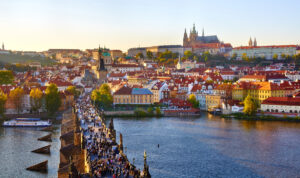
Prague, the capital of the Czech Republic, is one of Europe’s most beautiful cities, known for its rich history, stunning architecture, and vibrant cultural life. From the iconic Charles Bridge to the historic Prague Castle, the city blends medieval charm with a dynamic modern atmosphere. An international hub of science, innovation, and education, Prague provides an inspiring setting for international exchange, making it an ideal host for RRFM 2027.

VISA

Citizens from countries outside of the Schengen area might need a visa to enter the Czech Republic.

Upon request, the European Nuclear Society will prepare a visa invitation letter for delegates whose registration fees have been received in full. Unfortunately, we are not in a position to give any further support to the visa application process. Obtaining a visa remains the sole responsibility of the participant. Regular cancellation deadlines apply, regardless of whether your visa was granted or not.

GETTING THERE

The Grandium Hotel is located in the city centre, just 15 minutes by walking from the Prague Central Station (see here) and 2 minutes from the Florenc Metro Station (lines B and C) (see here).
Prague is served by the Vaclav Havel International Airport, the largest airport in the Czech Republic and one of the largest airports in Central and Eastern Europe. The airport is well served by public transport (buses and trolleybuses), which connect it to the city centre (visit the website). Prague Central Station (Praha hlavní nádraží) also has international, frequent connections, handling services to Germany, Poland, Slovakia, Austria, Hungary, and Switzerland.

ORGANISER

European Nuclear Society

Avenue des Arts 56
1000 Brussels, Belgium
Email: conferences@euronuclear.org 

European Research Reactor Conference is an ENS Conference