ENS – “How it began”
by Pierre C. Zaleski
ENS 50th anniversary, Vienna, 15 September 2025
During our anniversary, we had the great pleasure of hosting Pierre Zaleski, ENS President from 1981 to 1983.
Mr Zaleski’s speech has been a fantastic opportunity to explore the origins and the first steps of ENS, dating back to the early 1970s.
The need for nuclear professionals to be represented, as well as to communicate to the public about nuclear science, technologies and the community’s activities, led to the founding of ENS in 1975, when the first European Nuclear Conference took place.
Here is the text of the speech that Mr Zaleski delivered at the ENS 50th Anniversary in Vienna, on 15th September 2025.
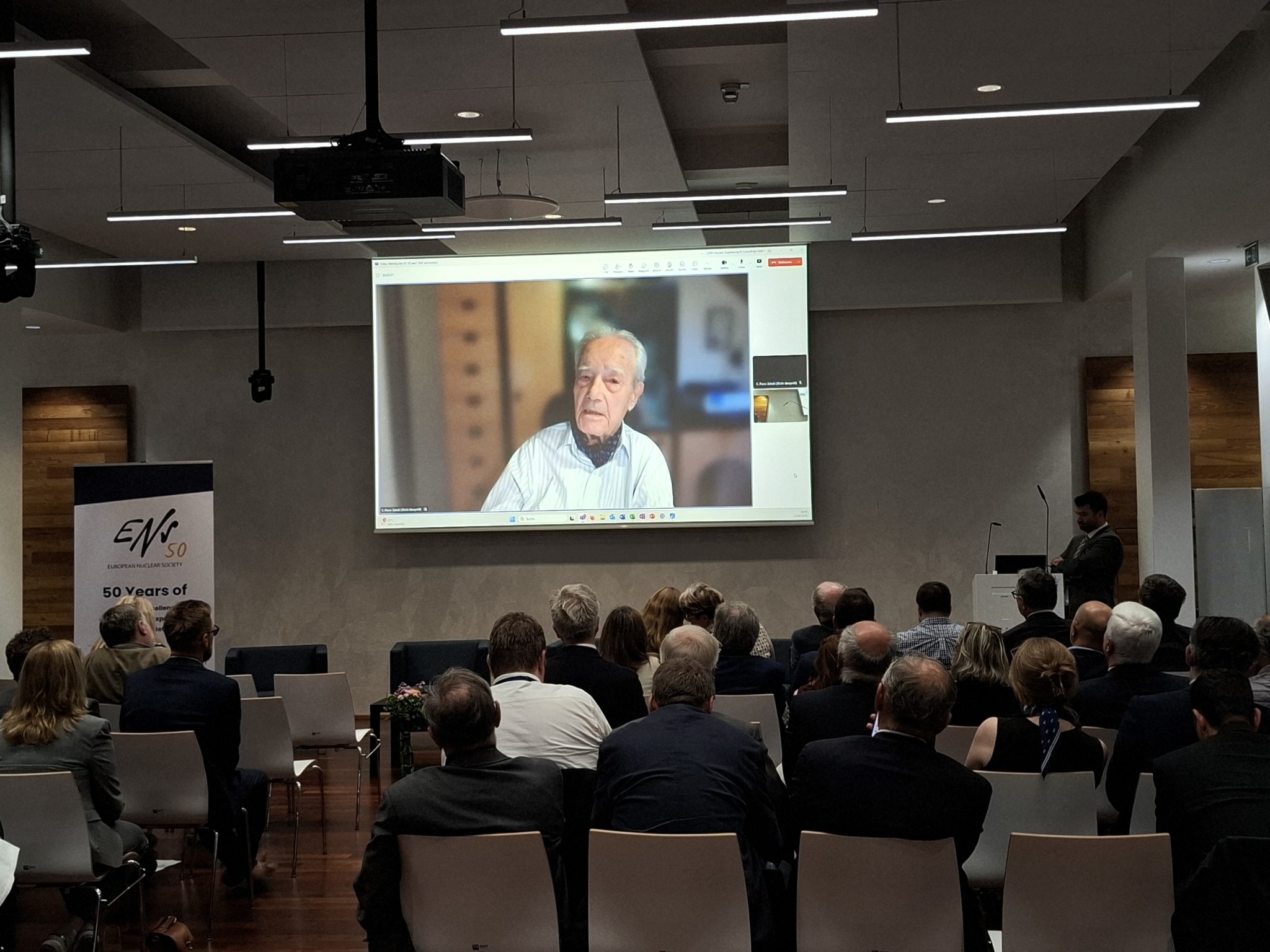
C. Pierre Zaleski delivering his speech at the ENS 50th Anniversary in Vienna, 15th September 2025.
As the nuclear sector in Europe attained a certain maturity at the beginning of the 1970s – around 1972–1973 – the need was felt to better organize cooperation among specialists, engineers, physicists, chemists, and, in general, all those concerned with nuclear energy, within an appropriate geographical framework: on the level of Europe, a continent that, while accounting for a third of the world’s nuclear activities, is small enough to allow for effective contacts and interactions.
This was particularly our view at the recently founded French Nuclear Energy Society, SFEN, of which Rémy Carle was chairman and I was secretary general. Our view was shared by influential figures of the French nuclear sector. We considered that a new European nuclear association was the answer.
The idea behind this new association was also to communicate with the public, decision-makers, and politicians about nuclear energy and about our activities, to allow them to form opinions based on objective and rational information.
The American Nuclear Society (ANS), which had been founded 20 years earlier — and had many European members, including myself, as well as three European sections — provided an interesting example to follow.
In the United States, alongside the scientific society ANS, the nuclear industry had also founded a separate lobby association, the Atomic Industrial Forum. That model was also later adopted in Europe, giving rise to national forums and eventually to ENS’ sister association Foratom, now NuclearEurope.
However, the existence of diverse languages, cultures, and national institutions in Europe made it unrealistic (at least at the time) to create an association of individuals like ANS — hence the idea that it would be better to organise a federation of national associations.
Michel Féron, Director of Generation & Transmission at Electricité de France, and I travelled across Europe to present this project to key people in the sector. After numerous discussions with national nuclear associations and influential figures in industry, research and electricity generation, this proposed structure was adopted by consensus.
The list of our contacts during this “road trip” is long, but let me cite just two examples of nuclear statesmen we consulted:
- Sir John Hill, chairman of the United Kingdom Atomic Energy Authority, and
- Professor Dr. Heinrich Mandel, chairman of German utility RWE.
Finally, the first meeting of what would become ENS was held in April 1973 in Karlsruhe. One may see a certain irony in the fact that the agreement was sealed in a country that 25 years later declared itself antinuclear…
In Karlsruhe, the decision was made to organise a major European conference to officially launch ENS.
France was tasked with organising this major conference — the first European Nuclear Conference, ENC — in Paris in April 1975. It was there, on the eve of the conference on April 20, that the signatures officially creating ENS were affixed to the statutes.
The key figures of the first ENC were André Giraud, the “General Chairman,” and Marcel Boiteux, who headed, respectively, the French Atomic Energy Commission and EDF. I had the honour of serving this conference as Executive Chairman. It was no easy task!
This first ENC was a great success:
- more than 3,000 participants from around the world;
- 7 plenary sessions, with an opening address by French Prime Minister Jacques Chirac;
- 26 parallel sessions on 10 technical themes
… all spread over a week.
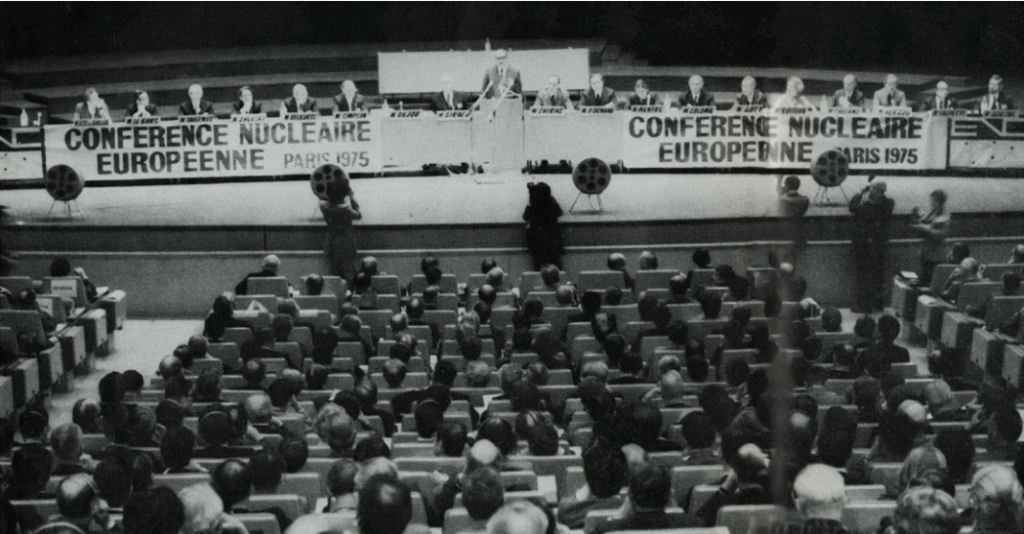
The first European Nuclear Conference, ENC — in Paris, April 1975
This was followed by the publication of 13 volumes of proceedings, the first covering the plenary sessions and the other 12 covering the technical sessions.
The conference also benefited greatly from the collaboration of ANS, and in particular from its president of 1973–74: John Simpson, president of Westinghouse Power Systems from 1969 to 1977. In fact, Simpson was one of three vice-general chairs of the ENC.
In the years that followed, ENS, taking advantage of the dynamism of nuclear energy in Europe, grew significantly, eventually comprising 17 national societies in 1981, 23 in 1991 (including the USSR Nuclear Society) and 27 in 2001 (including the Russian Nuclear Society).
In 1981, the Society was able to launch a monthly journal – Nuclear Europe (it seemed like a good name…). The journal had a circulation of 15,000 copies, including 13,000 for members of the federated association.
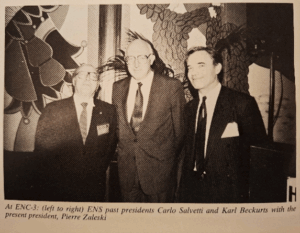
C. Pierre Zaleski (on the right) with two ENS past presidents, at ENC-3 (From Nuclear Europe #5 – May 1982).
In its prime, ENS sponsored up to 10 scientific meetings per year as well as a major general conference approximately every three years.
Despite the challenges that nuclear energy has experienced since that time – economic downturns, political opposition, and a major nuclear accident at Europe’s doorstep – the European Nuclear Society is still very much alive.
Let us hope that with the renewed interest in nuclear energy, particularly in Europe, ENS will also thrive and be able to develop further.
When we think back to what we knew, and what we expected, 50 years ago, and where we are now, can we imagine what it will be like 50 years from now?
Pierre Zaleski
ENS President 1981-1983