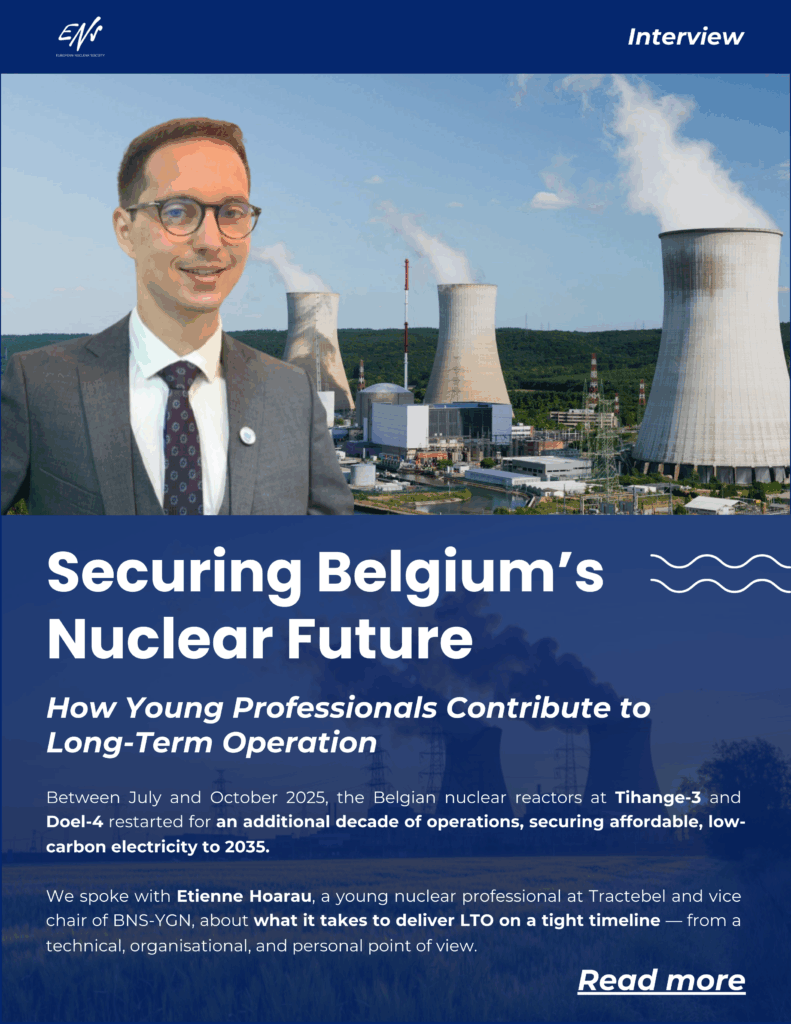
Securing Belgium’s Nuclear Future
How Young Professionals Contribute to Long-Term Operation
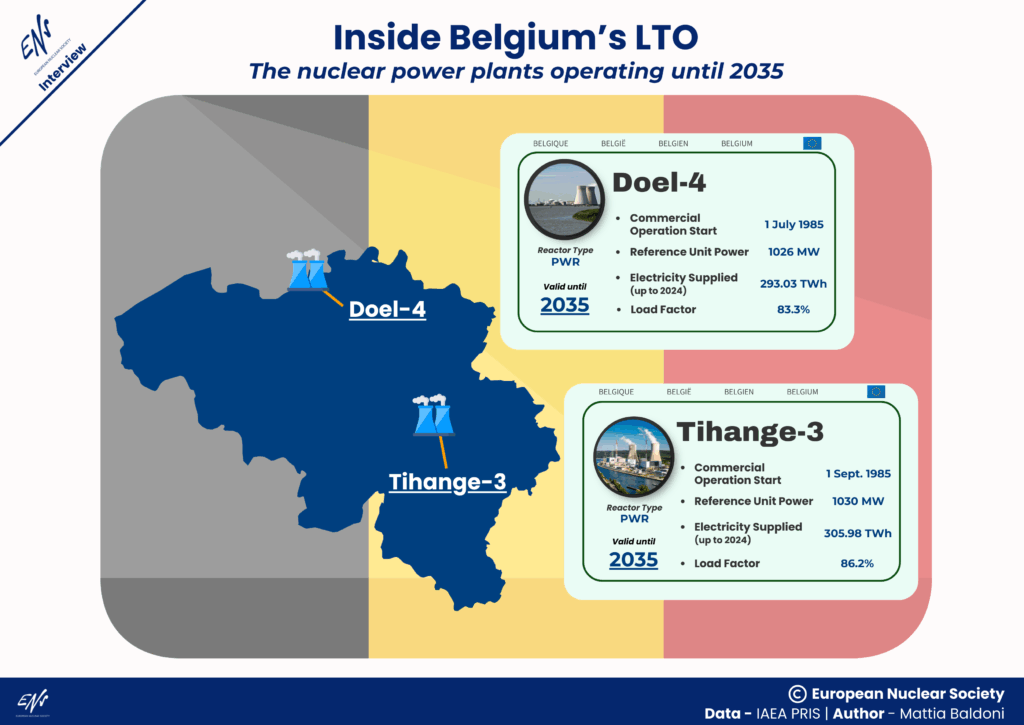
In early July 2025, Belgium’s nuclear regulator FANC (Federal Agency for Nuclear Control) cleared the restart and continued operation of Tihange-3 after a major LTO outage—an important step toward securing affordable, low-carbon electricity to 2035. Similarly, Doel-4 restarted early October, reaching full power on the 10th.
We spoke with Etienne Hoarau, a young nuclear professional at Tractebel and vice chair of Belgian Nuclear Society – Young Generation Network, about what it takes to deliver LTO on a tight timeline—technically, organizationally, and personally.
-
Etienne, for readers new to LTO: in simple terms, what just happened with Tihange-3, and what’s next for Doel-4?
Tihange-3 and Doel-4 are the youngest nuclear power plants in operation in Belgium. They both started their operations over the summer of 1985, so this year they celebrate 40 years of electricity production, with a remarkable average capacity factor close to 85%[1]. Of course, like all machines and power plants, nuclear ones also require maintenance, controls and ageing management to ensure their efficient and safe long-term operation.
In this specific case, following the decision to keep these two plants operating, intensive consultations, studies and verifications have been carried out over the last years, and the final results have finally been submitted to the Belgian nuclear regulator (FANC). Concerning Tihange-3, FANC approved this massive revision project – which is the LTO dossier “Plan d’Action Global”[2] – and gave it greenlight to restart and operate the plant for the next decade. Similarly, the dedicated dossier has more recently been accepted for Doel NPP.
-
Could you briefly explain why these milestones are so important for Belgium’s energy system and for Europe more broadly (reliability, affordability, climate…)?
How does LTO contribute to grid stability and price resilience in the coming winters (and beyond)?
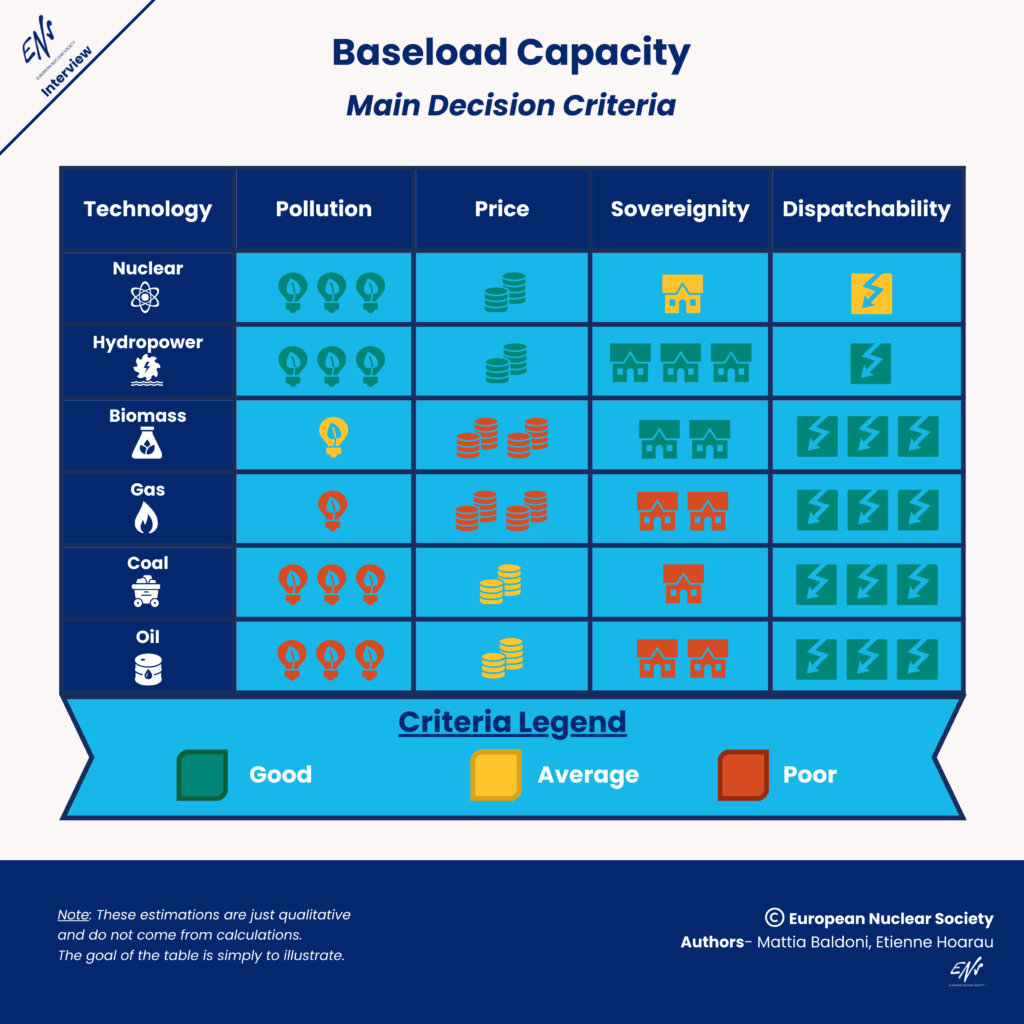
Indeed, the toughness of the winters in Belgium requires an extra amount of electricity during this period. The storage capacity existing today does not allow for covering this extra need, so the country relies then on production means running constantly and steadily, called “baseload capacities”. The main baseload capacities are nuclear, hydropower, biomass, gas, coal, and oil.
Once these capacities are identified, a choice must be made depending on the technology itself. Hereunder is a simplified table to explain the main decision criteria:
When a government is establishing its electricity roadmap – the strategy – it relies on analysis of this type and decides how the country will be powered in the coming years.
In the case of Belgium, the context changed drastically at the beginning of the 2020’s, with, amongst others, the war in Ukraine. The country’s strategy needed to be revised at the last minute and then the main criteria became “What is available for the winters 2025, 2026 and 2027”.
The reasons why nuclear has been reconsidered and is today a key player in the electricity mix come from its intrinsic advantages:
- Land occupation is very limited compared to other production means
- CO2 emissions at the lowest level
- Highly qualified jobs and positions for local people
And in the case of LTO, the main drawbacks, which are initial investments and waste management, are largely diminished:
- Waste management: The LTO is a real opportunity to consolidate the funds dedicated to waste management projects for the future
- Initial investment: Limited because the plant is already built, people are already trained, and all the supply chain is already ready.
So, this urgent need for electricity supply during the upcoming winters will be covered by existing plants, which are operated in a manner that keeps them at a high level of safety. The effort to reach the requested safety level for an LTO is therefore limited.
I’ve recently participated in a panel session on LTO at the 51st Annual Meeting of the Spanish Nuclear Society, and I would like to quote Garry G. Young (Technical Executive, LTO and Ageing Management Strategy Nuclear at EPRI), on stage with me. As he said,
“The best you can do as a plant owner to prepare for LTO in the future is to ensure in your daily work the highest level of quality and continuous improvement, making the option of LTO easier to implement when the time comes.”
Thanks to this operational excellence, it has been possible to develop a Flex LTO where the necessary modifications and upgrades allowing the plant to go 10 years forward will be made during the summer of the coming years while the plant safely produces energy for the country during the winters.
-
Could you tell us about your role in these LTO projects?
What are you personally working on day-to-day?
For the LTO, I am part of the Programme Management Team. This team has the role of gathering the information. Indeed, an LTO programme consists of more than a hundred projects working in parallel to perform the different tasks included in the global action list.
Our role is to:
- Validate the completion of the actions (contained in the famous ‘Global Action List’)
- Gather global financial information and develop visions on the LTO budget
- Communicate – Good communication is key in such large projects!
- Communication of our progress to the directors of the plant but also to the authorities
- Communication to the other projects, constantly working to make the LTO a reality
- Communication between Bruxelles, Tihange and Doel to align visions and share progress.
In my specific case, I oversee the committee’s work to validate the completion of actions and prepare part of the communications supported by our fantastic administrative team.
This role gives me the opportunity to develop an overview of all the activities that an LTO represents and challenges me to find ways to make the data speak for itself without it being a burden to the work teams.
The day-to-day is evolving, depending on the actions to be taken to optimise the programme. There is a steady part with the management of the global action list and room for opportunities, challenges and new ideas that suit me perfectly.

The LTO Programme
Technical & organisational challenges, compressed timelines, extraordinary teamwork
-
What does “preparing a reactor for long-term operation” involve from a technical and regulatory point of view?
….
Click below and continue reading the full interview!
- What does “preparing a reactor for long-term operation” involve from a technical and regulatory point of view?
- Your team have been praised for working under very tight schedules — what were the main schedule risks, and how were they managed?
- What motivated you to pursue a career in nuclear? And what does work on LTO mean to you personally?
… and many other questions!