Tokamak

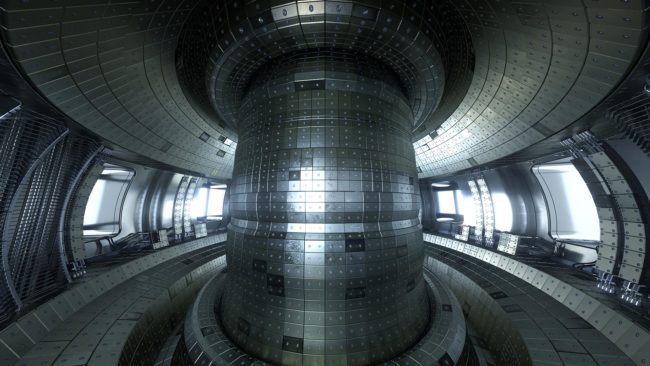
Experimental arrangement for controlled nuclear fusion. In a Tokamak, two superimposed magnetic fields enclose the plasma: this is the toroidal field generated by external coils on the one hand and the field of a flow in the plasma on the other hand. In the combined field, the field lines run helicoidally around the torus centre.…

Solidification

As a rule, radioactive waste becomes suitable for ultimate disposal by embedding in a matrix. The stability of the solidification product is adjusted to the requirements of the type of waste, for instance, radiotoxicity, decay heat, half-life and others. Solidification criteria are: mechanical resistance to avoid dispersion, radiation protection resistance to avoid radiolysis, thermal conductivity…

Food and Agriculture

Food and agricultureNuclear technology for food and agriculture It is expected that by 2050, the world’s population will have increased by one-third, with the highest increase occurring in developing countries; and with it, our needs for sustainable food and water as well. Nuclear technologies provide competitive and often unique solutions to help fight hunger and…

Innovation

Innovation The applications of nuclear are continually being furthered by innovative research. Clean energy futures In order to provide a reliable baseload supply to the energy grid which is also a clean, low carbon source of energy, nuclear power is required. Three generations of nuclear reactors have provided clean electricity for over 50 years, however…

Max Planck Institute for Plasma Physics

The Max-Planck-Institut für Plasmaphysik (IPP) is concerned with investigating the physical fundamentals underlying a fusion power plant which – like the sun – is designed to gain energy from the fusion of light atomic nuclei. The two concepts for the magnetic confinement of fusion plasma – Tokamak arrangement and stellarator principle – are examined for…

MAK

Threshold limit value. This value is the highest permissible concentration of a working material as a gas, steam or suspended matter in the air at the working place. According to the present state of knowledge, this concentration generally does not affect the health of the workers or cause undue nuisance even with repeated and long-term,…

Incident/accident levels

The notifiable events in nuclear facilities in Germany are classified on different levels in accordance with AtSMV corresponding to their importance with respect to safety. Level S: This level comprises such events which must be reported immediately to the damage inspection officials so that they can initiate examinations at short notice or cause measures to…

Fusion

Formation of a heavy nucleus from lighter nuclei releasing energy – the binding energy. Possible fusion reactions: D + T -> 4He + n + 17.58 MeV, D + D -> 3He + n + 3.27 MeV, D + D -> T + p + 4.03 MeV, D + 3He -> 4He + p +…